
Article: The Modern Ritual: Why Humans Still Burn Things to Feel Something

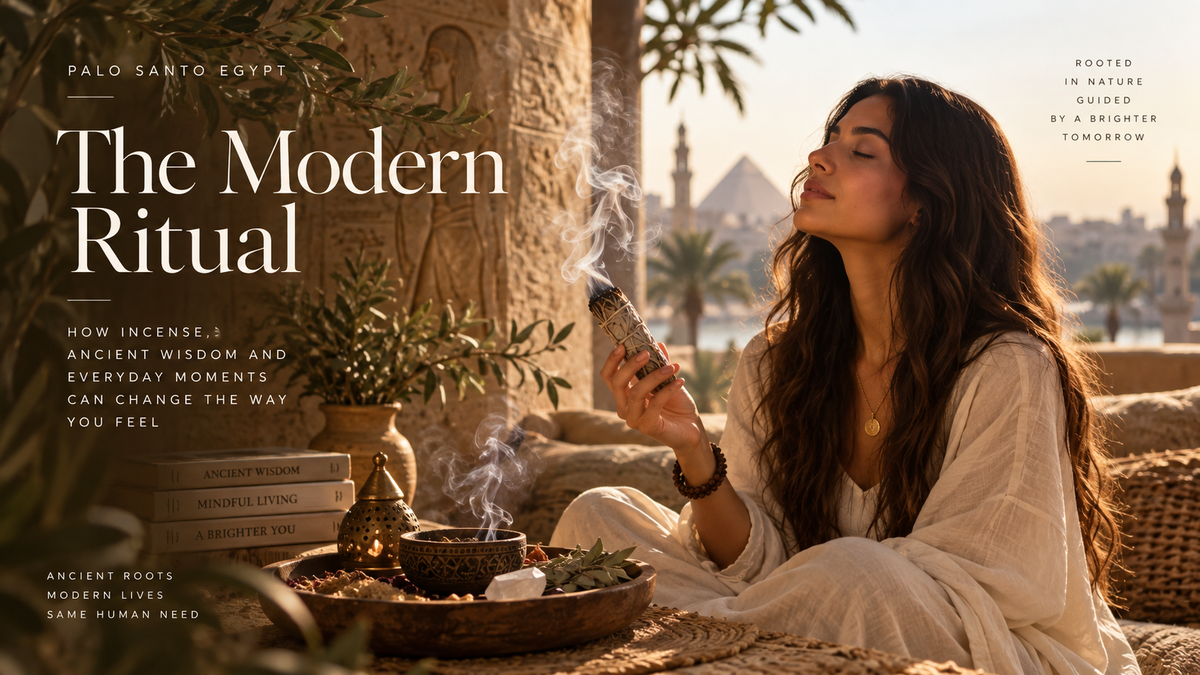
The Modern Ritual: Why Humans Still Burn Things to Feel Something
The Modern Ritual, Why Humans Still Burn Things to Feel Something
From ancient Egyptian temples to the five quiet minutes we create for ourselves today.
There is something strangely familiar about lighting incense.
You strike a match.
Wait for the flame.
Blow it out.
Watch the smoke change the air.

For a few minutes, you do something humans have been doing for thousands of years.
We might call it a ritual today. But a ritual doesn’t have to be religious, mystical or complicated.
Making coffee before everyone wakes up can be a ritual.
Lighting something when you come home from work can be a ritual.
Taking a bath after a difficult day.
Opening the windows on Saturday morning.
Burning incense before friends arrive.
Sometimes a ritual is simply an ordinary action that tells your brain: something is changing now.
Your nose has a surprisingly direct relationship with emotion
Scent isn’t just decoration for a room.

The olfactory system interacts closely with brain regions involved in emotion, memory and emotional learning.
Research has repeatedly found connections between odor perception and areas including the amygdala and orbitofrontal cortex; interestingly, anxiety can also change the way the brain processes smells.
That may help explain something many of us already know intuitively:
A smell can change the feeling of a moment incredibly quickly.
A particular perfume can bring back a person.
Coffee can feel like morning before you’ve even taken a sip.
A familiar incense can remind you of your grandmother’s house, a church, a mosque, a holiday, a hotel or a place you haven’t thought about for years.
The response isn’t necessarily magical.
It’s profoundly human.

Research on fragrance and aromatherapy suggests that odors can influence mood, physiology and behaviour, although expectations, personal memories, culture and previous associations with a scent can all contribute to the effect. Some randomized trials of aromatherapy have also reported reductions in anxiety, but that evidence shouldn’t be interpreted as incense being a treatment for anxiety disorders.
Maybe the ritual matters too.
There is another part we sometimes overlook.
When you decide to light incense, dim the lights, make tea and sit down for ten minutes, the fragrance isn’t the only thing happening.
You’ve interrupted whatever you were doing.
You’ve changed the environment.
You’ve given your attention a new object.
You’ve created a beginning and an ending.
That is why, at Palo Santo Egypt, we’re interested in the idea of the modern ritual.
Not instructions you have to follow.
Not something you have to believe.
Just small intentional acts that create a transition between one part of life and another.
Work → home.
Noise → quiet.
Guests arriving → home ready.
Awake → sleep.
Yesterday → a new morning.
⸻

Egyptians have understood the power of scent for a very long time.
Long before the modern fragrance industry existed, aromatic materials were deeply embedded in ancient Egyptian religious and daily life.
Incense was burned in temples and offered to deities, and aromatic resins and preparations were connected with purification, ceremony and the divine. One of the most famous Egyptian preparations was kyphi, a complex aromatic mixture whose recipes varied over time and included ingredients such as resins, wine and other botanicals.
But Egypt’s relationship with scent didn’t disappear with the pharaohs.
It changed.
Walk through Egyptian life today and fragrance is still everywhere: bakhour, incense, perfumes, oils and aromatic smoke appear in homes, shops and places of worship. Incense use remains culturally common across North African and Arab communities.
The reasons aren’t always the same.
For one person it is faith.
For another, hospitality.
For another, family tradition.
And for someone else, the house simply doesn’t feel properly cleaned until it smells a certain way.
Different century. Different meaning. Same human instinct to change a space through scent.

⸻
So what does a modern ritual look like?
Whatever you need it to.
Burn cedar while you tidy your apartment.
Light Palo Santo after closing your laptop.
Make mountain rose tea and put your phone somewhere you can’t reach it.
Burn incense while you’re getting dressed to go out.
Light a candle when someone you love comes over.
Open your windows, put on music and burn the incense your mother used at home.
There doesn’t need to be a rulebook.
And there doesn’t need to be a spiritual explanation for everything.
The meaning comes from what the moment means to you.
You don’t need to fill a room with smoke for a moment to feel intentional.

A little is enough. Open a window. Let the scent remain after the smoke has gone.
⸻
Perhaps ritual never disappeared.
Maybe we simply stopped calling many of our rituals rituals.
The ancient Egyptians burned aromatics for reasons that belonged to their world.
Our grandparents had theirs.
And today, somewhere between notifications, deadlines, traffic and screens, we’re creating new ones.
Not necessarily because we want to escape modern life.
Sometimes we just need a small way to mark a moment inside it.
At Palo Santo Egypt, that’s what interests us most.
Not telling you what your ritual should mean.
Just giving you beautiful things with histories, scents and stories and leaving the meaning to you.
Light something. Make some tea. Open a window.
The rest is yours.
— Passant Thabet

Written by Passant Thabet
Leave a comment
This site is protected by hCaptcha and the hCaptcha Privacy Policy and Terms of Service apply.